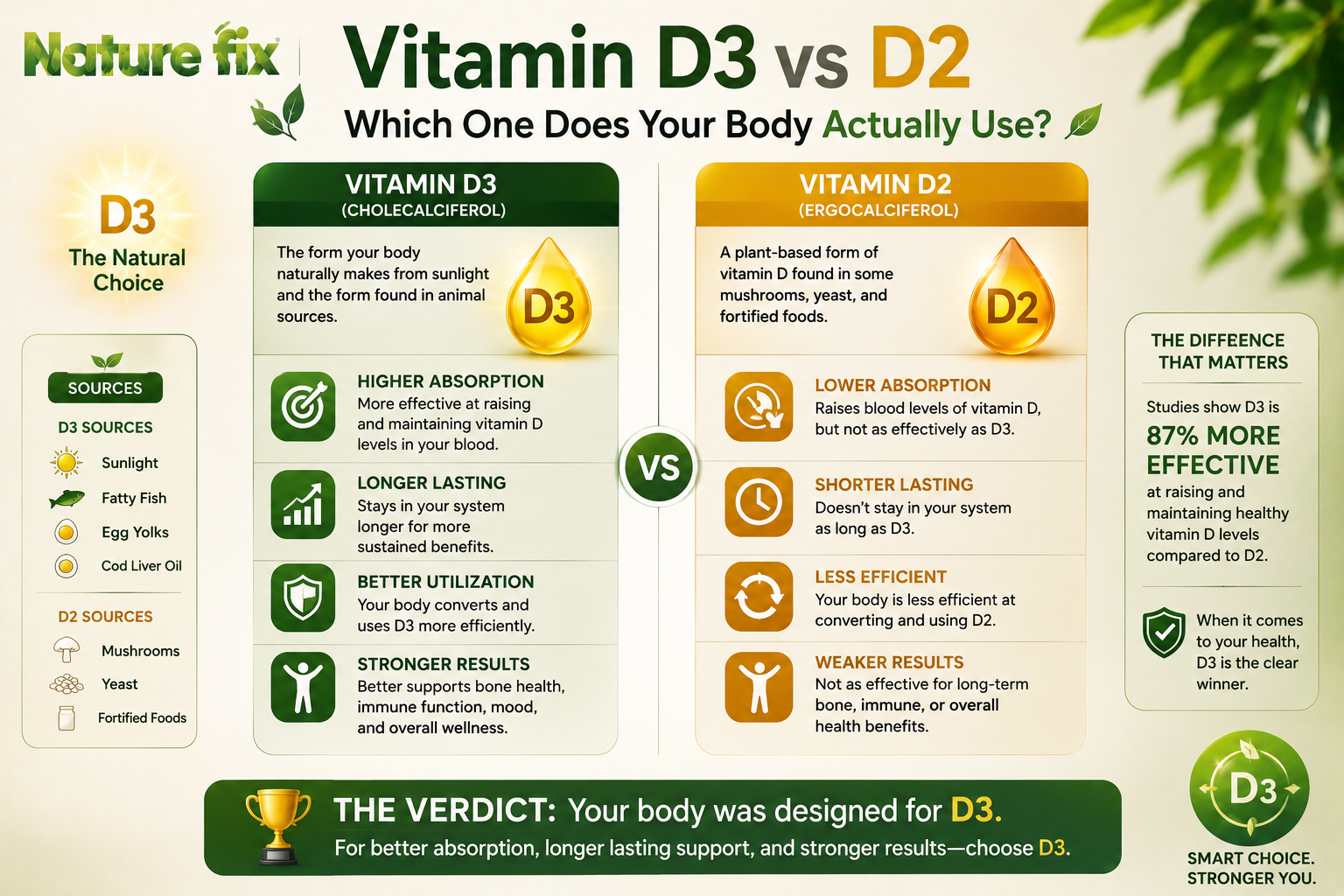
Most supplement labels just say “Vitamin D” without telling you which form is inside. That gap matters more than people realise because your body treats D3 and D2 very differently. One absorbs quickly, stays in your system longer, and works the way your body expects it to. The other does not.
Vitamin D is not just about bones. It touches your immune system, your mood, your sleep, your muscle strength, and your hormone balance. Getting the wrong form or not enough of it affects all of these areas quietly, over time, without obvious warning signs.
Here is everything you actually need to know without the confusion.
What Does Vitamin D Do in Your Body?
Your skin makes vitamin D when sunlight hits it. That vitamin then travels through your bloodstream and gets converted into an active hormone-like compound that your body uses in hundreds of ways every single day.
When your vitamin D is low, you will not necessarily feel one specific thing. You will feel a collection of vague, easy-to-ignore symptoms:
- Tiredness that sleep does not fix
- Low mood or feeling flat without a clear reason
- Getting sick more often than you should
- Aching muscles or stiff joints especially in the morning
- Poor sleep quality even when you are in bed long enough
- Weak nails, hair thinning, or dry skin
The tricky part? All of these symptoms can be blamed on other things stress, bad sleep, ageing, a busy schedule. Most people never connect them to vitamin D until a blood test reveals their levels are far lower than they should be.
Quick Fact: Studies consistently show that 70 to 90 percent of urban adults in India are vitamin D deficient despite living in one of the sunniest countries in the world. Office jobs, sunscreen, pollution, and covered clothing all block the sunlight the body needs to make its own D.
So What Is the Difference Between D3 and D2?
Both are forms of vitamin D. Both can raise your blood levels to some degree. But D3 does it better and the gap is meaningful enough that it genuinely changes how effective your supplement is.
| Vitamin D3 | Vitamin D2 | |
| Source | Sunlight · Fish · Lichen (vegan) | Fungi · Yeast · Plants |
| Absorption | High | Lower |
| Stays active | Longer in bloodstream | Clears faster |
| Raises D level | More effectively | Less effectively |
| Best choice? | ✔ Yes — always prefer D3 | ✘ Use only if D3 unavailable |
D3 cholecalciferol is what your skin naturally produces from sunlight. It is found in oily fish, egg yolks, and liver. For people who do not eat animal products, it can also be made from lichen a plant-based source which is how Nature Fix sources its D3.
D2 ergocalciferol comes from fungi and plants. It was historically used in prescription vitamin D because it was cheaper to produce. Research has since shown consistently that D3 raises blood levels more effectively and holds those levels for longer. Most nutrition researchers now recommend D3 as the first choice.
The Bottom Line: If your supplement says Vitamin D without specifying D3, it might be D2. Check the label. Always choose D3 wherever possible your body uses it more efficiently and keeps it active for longer.
Can You Just Get It from Sunlight?
This is the most common question and the honest answer is: for most people living modern lives, sunlight alone is not enough.
To make meaningful vitamin D from sunlight, your skin needs direct UVB exposure not through glass, not early morning or late afternoon light, and not when sunscreen is applied. For most working adults, that window simply does not exist in daily life.
Here is what actually blocks your D production every single day:
✘ Working indoors from 9am to 6pm behind windows that filter UVB
✘ Wearing sunscreen whenever you are outside
✘ Air pollution filtering out UVB rays in urban areas
✘ Darker skin tones requiring significantly more sun exposure to produce the same D
✘ Age the skin becomes less efficient at D synthesis after 40
Going outside is still valuable for movement, fresh air, and mental clarity. But relying on it as your primary vitamin D source, particularly in a city, is an approach that leaves most people deficient without knowing it.
Why D3 Works Best When Paired with K2?
Here is something most supplement labels do not explain: vitamin D3 increases the amount of calcium your body absorbs from food. That sounds straightforwardly good and it is but there is a catch.
When you absorb more calcium, your body needs to know where to send it. Calcium belongs in your bones and teeth. It does not belong in your arteries or soft tissue. Left to chance, it can end up in places it should not.
This is exactly where vitamin K2 comes in. K2 activates proteins that guide calcium directly into bone tissue and actively prevent it from depositing in arterial walls. It is not an optional add-on it is the partner nutrient that makes D3 work the way it is supposed to.
Think of It This Way: D3 opens the door for calcium to enter your body. K2 makes sure it goes to the right room your bones instead of causing problems elsewhere. One without the other is an incomplete solution.
This is the reason Nature Fix formulates Vitamin D3 together with K2. Not as a marketing decision, but because the science consistently shows these two nutrients work as a team and supplementing one without the other misses a significant part of what your body actually needs.
How Much Vitamin D3 Do You Actually Need?
The right amount depends on your current blood levels, your age, your skin tone, and how much sun you realistically get. Here is a simple way to think about it:
✔ Desk job, mostly indoors, urban life aim for 1,000 to 2,000 IU daily
✔ Over 50 or darker skin tone lean toward 1,500 to 2,000 IU daily
✔ Confirmed deficiency from a blood test ask your doctor about a higher dose temporarily
✔ Take your D3+K2 with your largest meal of the day fat in food helps absorption
✔ Be consistent
The upper safe limit for most adults is generally 4,000 IU per day from supplements. Going above that should only happen under medical guidance. For most people, 1,000 to 2,000 IU daily is a practical, evidence-aligned starting point.
Why Nature Fix Vitamin D3 + K2
There are a lot of vitamin D supplements on the market. Most of them list D on the label, fill the capsule with D2, skip the K2, and call it done. Here is what actually matters when you are choosing one:
✔ D3 not D2. Nature Fix uses cholecalciferol the form your body produces from sunlight and absorbs most efficiently
✔ Sourced from lichen plant-derived D3, fully suitable for vegetarians and vegans
✔ Paired with K2 because D3 without K2 is an incomplete formula for bone health and calcium management
✔ Clean ingredients no artificial fillers, colours, or anything you would need to question
✔ Transparent label every ingredient listed with its source
One capsule a day. With food. At a consistent time. That is genuinely all it takes to give your vitamin D levels the reliable daily support most people have been missing without knowing it.
Order Nature Fix Vitamin D3 + K2 at getnaturefix.com lichen-sourced, K2-paired, clean formula.
D3 over D2. K2 alongside D3. Daily. With food. Consistently.
That is the whole formula for getting vitamin D right.
For informational purposes only. Consult a healthcare professional before starting any supplement. © 2026 Nature Fix | getnaturefix.com