What you were told about calcium may be wrong and the truth is more important than you think
Calcium is one of those nutrients that everybody thinks they understand. Drink your milk. Eat your dairy. Take a supplement if needed. Done.
But the reality is far more complicated and far more interesting than that. There are widespread misconceptions about calcium that are so deeply ingrained that most people never question them. And some of those misconceptions are not just unhelpful. They could actually be working against your health.
In this guide, we are going to break down the most common calcium myths one by one, explain what the science actually says, and show you what genuinely effective calcium support looks like in practice.
The Calcium Myths At a Glance
Before we go into detail, here is a quick overview of the myths we are going to cover and the truth behind each one:
| The Myth | The Truth |
| “Drink milk and you will be fine” | Dairy alone rarely meets adult daily calcium needs, and absorption decreases with age |
| “The more calcium, the better” | Excess calcium without co-nutrients can deposit in arteries, not bones |
| “Calcium works on its own” | Without Vitamin D3 and K2, calcium cannot be properly absorbed or directed to bones |
| “All calcium supplements are the same” | Calcium citrate malate absorbs significantly better than carbonate, especially without food |
| “Only women need to worry about calcium” | Men lose bone density with age too — calcium is essential for everyone |
| “You stop needing calcium after 40” | Bone maintenance requires calcium intake throughout life, not just during growth years |
MYTH 1: “Drinking Milk Every Day Gives You All the Calcium You Need”
THE TRUTH: Dairy helps but it is rarely enough on its own.
This is probably the most common calcium belief of all, and it is one that has been repeated so many times it feels like an established fact. The reality is more nuanced.
Yes, dairy products contain calcium. A glass of milk provides around 300mg. But the average adult needs between 1,000mg and 1,200mg of calcium per day and that number only increases for people over 50 and for women post-menopause.
Meeting those levels through dairy alone would mean consuming three to four full servings of milk or cheese every single day. Most people do not come close to that consistently. And for those who are lactose intolerant, avoid dairy for ethical reasons, or simply do not enjoy it, the gap is even wider.
Even regular dairy consumers often fall short of their actual daily calcium requirement particularly as absorption efficiency decreases with age.
Beyond quantity, there is also the issue of absorption. Not all calcium from food gets used by your body. Factors like your age, your Vitamin D levels, and the overall composition of your meal all affect how much calcium actually makes it into your bloodstream and eventually your bones.
Bottom Line: Dairy is a useful source of calcium but not a sufficient one for most adults. Relying on it alone, without tracking intake or supplementing, leaves many people chronically under-supplied.
Explore smart supplementation options at getnaturefix.com.
MYTH 2: “The More Calcium You Take, the Stronger Your Bones Will Be”
THE TRUTH: More is not always better in fact, too much can be harmful.
It sounds logical. Bones are made of calcium. So taking more calcium should mean stronger bones, right?
Not quite. The body has a tightly regulated system for managing calcium. When you consume more than it can use or safely process, the excess has to go somewhere and research suggests it does not always go where you want it to.
Studies have found links between very high calcium intake particularly from supplements taken without the supporting nutrients Vitamin D3 and K2 and calcium deposits in soft tissues, including arterial walls. This is sometimes called arterial calcification, and it is the opposite of what any calcium supplement is supposed to achieve.
Flooding your system with calcium without the right co-nutrients to guide it does not strengthen your bones. It may instead direct calcium toward places in the body where it does not belong.
The recommended upper safe limit for calcium from all sources combined is generally considered to be around 2,500mg per day for most adults. Going significantly above that on a regular basis particularly through unguided supplementation is not advisable.
The Takeaway: The goal is not maximum calcium intake. The goal is adequate, well-absorbed calcium that reaches your bones and that requires the right dose paired with the right supporting nutrients.
MYTH 3: “Calcium Supplements Work Fine on Their Own”
THE TRUTH: Calcium needs Vitamin D3 and K2 to do its job properly.
This is perhaps the most important myth on this list and the one with the most practical consequences for your health.
Calcium does not work in isolation. It is part of a nutrient partnership that involves two other vitamins that most people do not think about when they reach for a calcium supplement.
The first is Vitamin D3. Without adequate Vitamin D3, your intestines cannot absorb calcium efficiently from food or supplements. You can consume as much calcium as you like, but without D3 acting as the gatekeeper, most of it simply passes through your body unused.
The second is Vitamin K2. Once calcium has been absorbed into the bloodstream, it needs to be directed to the right places primarily your bones and teeth. Vitamin K2 activates proteins that guide calcium into bone tissue and help prevent it from being deposited in soft tissues like arteries and kidneys.
Think of it this way: Vitamin D3 opens the door for calcium to enter your body. Vitamin K2 makes sure it ends up in the right room your bones and not wandering into places it should not be.
A calcium supplement that does not include or account for Vitamin D3 and K2 is leaving a significant part of its potential benefit on the table. Worse, it may be contributing to the soft tissue calcium deposits we discussed under the previous myth.
Why This Matters: Nature Fix Calcium Citrate Malate is formulated with both Veg. Vitamin D3 (from lichen) and K2 specifically because calcium without these two co-nutrients is an incomplete solution.
See the full formula at getnaturefix.com.
MYTH 4: “All Calcium Supplements Are Basically the Same”
THE TRUTH: The form of calcium makes a significant difference to how well your body can use it
Walk into any pharmacy and you will see rows of calcium supplements. Most people pick one based on price or brand recognition without realising that the type of calcium inside the capsule matters enormously.
The two most commonly sold forms are calcium carbonate and calcium citrate malate. They are not interchangeable.
Calcium Carbonate
This is the cheapest and most widely available form. It contains a high percentage of elemental calcium, which makes it look attractive on a label. However, it requires stomach acid to break down and absorb properly, which means it must be taken with food. For people who produce less stomach acid which becomes more common with age absorption can be quite poor.
Calcium Citrate Malate
This form is considerably more bioavailable meaning a higher proportion of it is actually absorbed and used by your body. It does not require food or high stomach acid to absorb effectively, making it the superior choice for older adults or anyone who takes their supplement in the morning before eating.
Research consistently shows that calcium citrate malate outperforms calcium carbonate on absorption metrics often by a meaningful margin. When you are taking a supplement to address a genuine nutritional need, absorption efficiency is not a minor detail. It is the whole point.
Cheap calcium carbonate on an empty stomach may deliver far less usable calcium to your body than you think. The number on the label is not the number that reaches your bones.
Nature Fix Uses: Calcium Citrate Malate specifically chosen for superior absorption, gentleness on the digestive system, and compatibility with the D3 and K2 co-nutrients in the formula.
MYTH 5: “Only Women Need to Worry About Calcium and Bone Health”
THE TRUTH: Bone density loss affects men too calcium is for every adult.
Osteoporosis and bone density loss are often discussed primarily in the context of women particularly post-menopausal women, who do experience a significant and rapid drop in bone density as oestrogen levels fall.
But framing calcium as a women-only concern has left many men significantly under-supplemented. Men begin losing bone density gradually from their mid-thirties, and by their seventies, the rate of bone-related fractures in men is far higher than most people realise.
Hip fractures in older men, in particular, carry serious health consequences and the path to preventing them starts decades earlier with consistent calcium and Vitamin D intake.
Beyond bones, calcium plays roles that affect men and women equally:
- Muscle contraction including the heart muscle, which depends on calcium for every single beat
- Nerve signal transmission throughout the body
- Blood clotting and wound healing
- Enzyme function and cellular communication
“Calcium is for women” is a harmful oversimplification that has contributed to calcium deficiency being chronically overlooked in men. Every adult body regardless of gender needs adequate daily calcium throughout life.
MYTH 6: “If You Feel Fine, Your Calcium Levels Must Be Okay”
THE TRUTH: Calcium deficiency rarely causes obvious symptoms until real damage has already occurred.
This is perhaps the most dangerous myth of all precisely because it makes inaction feel reasonable.
Your body works extremely hard to keep blood calcium levels stable. When dietary intake is insufficient, it draws calcium from your bones to maintain that balance. This process called bone resorption happens silently. There is no pain, no obvious symptom, and no warning sign in the early stages.
By the time calcium deficiency becomes detectable through symptoms muscle cramps, dental problems, frequent fractures the underlying bone loss has often been progressing for years. Waiting until you feel something is not a reliable strategy.
Important: Regular dietary awareness and consistent supplementation are far more effective than waiting for symptoms that may not arrive until significant damage has already occurred.
The best approach is a proactive one ensuring your daily calcium intake from food and supplementation consistently meets your body’s needs, long before any deficiency has a chance to take hold.
Real Food Sources of Calcium Worth Knowing
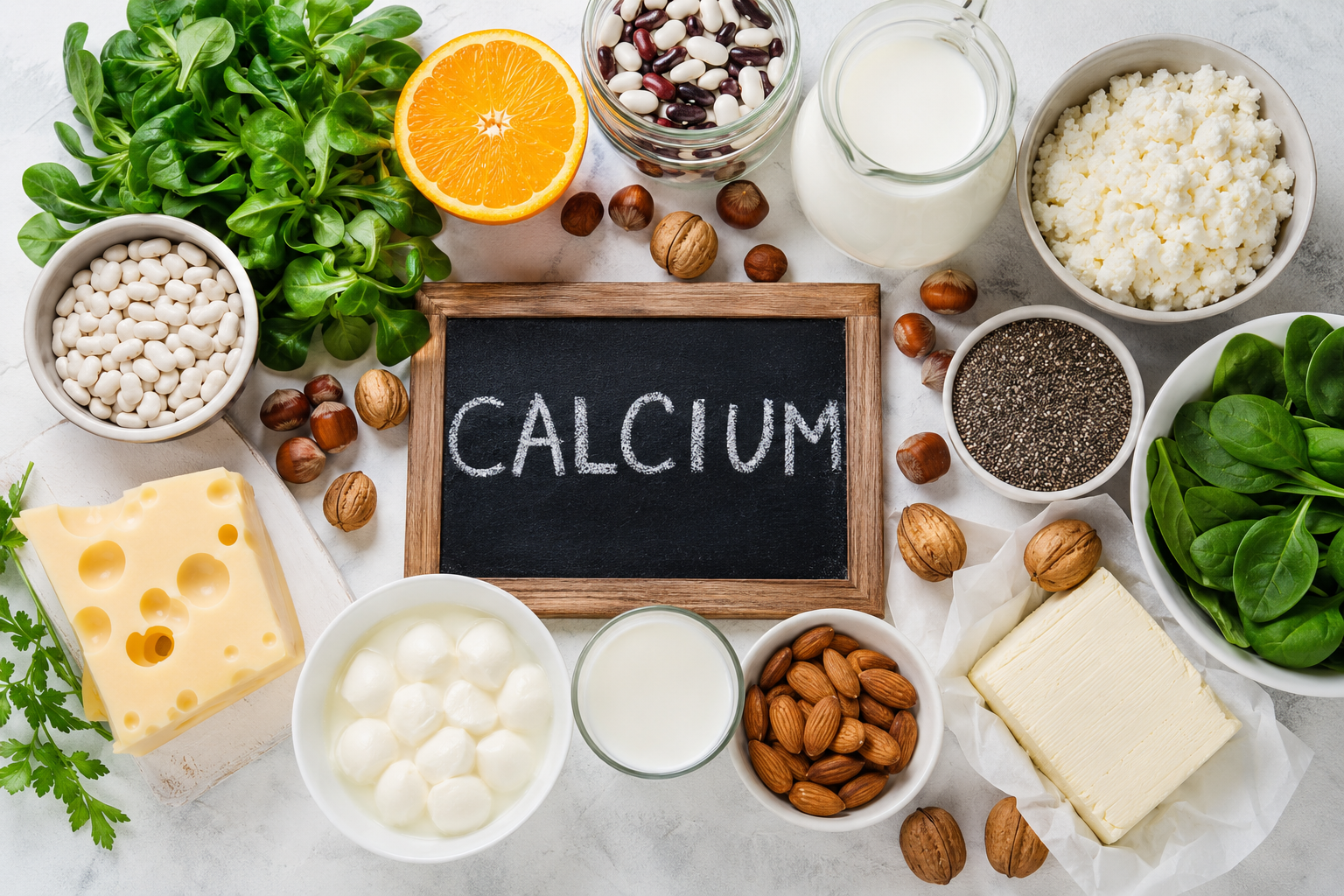
A good supplement should complement a healthy diet, not replace it. Here are the most reliable food sources of calcium to build your intake around:
- Dairy products milk, yoghurt, and cheese remain among the most concentrated food sources of calcium
- Leafy green vegetables kale, broccoli, and bok choy provide meaningful calcium alongside other key minerals
- Tofu made with calcium sulphate one of the best plant-based options and easy to incorporate into meals
- Canned sardines and salmon with bones the soft bones are edible and calcium-rich
- Almonds the most calcium-dense nut, useful as a daily snack
- Fortified plant milks oat, almond, and soy milks are often fortified with calcium comparable to dairy
- White beans and chickpeas a practical plant-based calcium contribution in everyday meals
Building meals around a variety of these sources throughout the day is the most reliable food-first approach. When that still falls short as it does for most adults a well-formulated supplement closes the gap.
How Nature Fix Calcium Gets It Right
Understanding the myths above makes it clear why most calcium supplements fall short. The form matters. The co-nutrients matter. The dose matters. And honesty about what is actually in the capsule matters.
Nature Fix Calcium Citrate Malate with Veg. Vitamin D3 (Lichen) and K2 is designed to address every one of the shortcomings we have covered in this guide:
✔ Calcium Citrate Malate form — significantly better absorbed than carbonate, with or without food
✔ Vitamin D3 from lichen — plant-sourced D3 that enhances calcium absorption in the intestine
✔ Vitamin K2 — activates the proteins that direct calcium into bone tissue and away from soft tissue
✔ Supports bones, joints, and muscle contraction — including cardiovascular muscle function
✔ Clean formula — no artificial colours, fillers, or unnecessary additives
✔ Transparent labelling — every ingredient listed clearly with its purpose
Whether you are in your thirties building bone density for the future, or in your sixties trying to preserve what you have, this formula gives your body the complete calcium support it actually needs not just the bare minimum.
Order Nature Fix Calcium Citrate Malate at getnaturefix.com and give your bones the support they deserve.
Final Thoughts
Calcium is not complicated once you cut through the myths. Your body needs it every day, it cannot store a large reserve of it, and most adults are not getting enough of the right kind in the right way.
The five myths we have covered are not fringe beliefs. They are widely held, casually repeated, and silently contributing to bone loss, poor absorption, and missed health opportunities for millions of people.
Now you know better. And knowing better means you can do better for your bones, your heart, your muscles, and your long-term health.
The right calcium. The right co-nutrients. The right form. Every single day.
Start making a real difference today visit getnaturefix.com to explore the full Nature Fix supplement range.