The Link Between Omega-3 and Healthy Aging
Getting older is something none of us can avoid. But how we age how we feel, how well our bodies work, and how sharp our minds stay is something we have far more control over than most people realise.
One of the most well-researched tools for aging well is also one of the simplest: Omega-3 fatty acids. Found naturally in oily fish, these essential fats do things inside your body that no other nutrient quite replicates. And yet most people are not getting nearly enough of them.
In this guide, we are going to walk you through what Omega-3 actually does as you age, why it matters more the older you get, and how to make sure your body is never running short of it.
What Happens to Your Body as You Get Older?
Aging is a gradual process. Most of the changes it brings happen slowly, quietly, and without obvious warning signs until they become noticeable problems. Some of the most common age-related changes include:
- The heart and arteries gradually become less flexible, making cardiovascular events more likely
- The brain starts to process information more slowly and memory becomes harder to hold onto
- Joints lose the cushioning that keeps movement smooth and pain-free
- Skin thins, dries out, and loses the elasticity that keeps it firm and smooth
- The immune system becomes less reliable at managing inflammation throughout the body
These changes are not inevitable in the way most people think. They are largely driven by inflammation — a slow, persistent internal process that accelerates when the body lacks the right nutrients to control it.
Key Insight: Chronic low-grade inflammation is widely considered one of the primary drivers of age-related decline. Omega-3 fatty acids are among the most effective natural compounds for managing it.
Omega-3 and Your Heart The Connection That Matters Most
Heart disease remains one of the leading health concerns for aging adults worldwide. As the years pass, the cardiovascular system works harder, arteries gradually stiffen, and maintaining healthy cholesterol and blood pressure becomes more challenging.
This is where EPA one of the two primary Omega-3 fatty acids found in fish oil plays a significant role. EPA supports the flexibility of arterial walls, helps maintain a healthy ratio of good to bad cholesterol, and reduces the kind of inflammation that puts unnecessary strain on the heart over time.
Studies consistently show that people who maintain adequate Omega-3 intake have measurably better cardiovascular outcomes as they age. It is not a dramatic overnight change it is the result of consistent daily support given to a system that works around the clock.
“Supportive but not conclusive research shows that consumption of EPA and DHA Omega-3 fatty acids may reduce the risk of coronary heart disease. Taking one Nature Fix Omega-3 softgel daily is one of the simplest steps you can take for your heart.”
To learn more about heart-supporting nutrition, visit Nature Fix at getnaturefix.com.
Keeping Your Brain Sharp – The Role of DHA
DHA is the most abundant fatty acid in the human brain. It makes up a significant portion of the grey matter that handles thinking, memory, and decision-making. When DHA levels in the brain are adequate, neurons communicate efficiently, mental tasks feel less demanding, and cognitive performance holds steadier over time.
When DHA is in short supply, the opposite happens. Research links chronically low DHA levels to faster cognitive decline, reduced memory performance, and increased risk of age-related brain conditions.
The challenge is that the brain cannot manufacture DHA on its own. It depends entirely on what you eat and supplement. As people age and dietary habits shift, DHA intake tends to drop exactly at the time the brain needs it most.
Did You Know? The average adult brain is roughly 60% fat by dry weight. DHA accounts for a large proportion of that fat, making consistent Omega-3 intake one of the most direct investments you can make in long-term brain health.
Supporting your brain with daily DHA does not mean your memory will become perfect or that cognitive aging will stop entirely. What it means is that you are giving your brain the building blocks it needs to function as well as possible for as long as possible.
Stiff Joints and Aching Muscles – How Omega-3 Helps
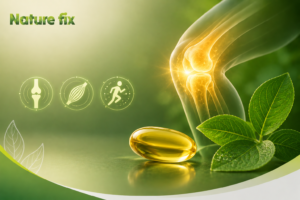
If you have ever woken up feeling stiff, needed a few minutes before your knees felt ready to walk properly, or noticed that recovery after physical activity takes longer than it used to you are experiencing something millions of aging adults deal with every day.
Much of this comes down to inflammation in and around the joints. As we get older, the cartilage that cushions our joints naturally thins, and the body is less efficient at managing the inflammatory signals that follow. The result is discomfort, reduced range of motion, and a gradual reluctance to stay active.
EPA and DHA work at a cellular level to moderate the production of inflammatory compounds. Multiple large-scale studies have found that consistent Omega-3 supplementation leads to meaningful reductions in joint stiffness and discomfort, particularly in people who have been experiencing age-related joint issues for some time.
✔ Most people notice a gradual improvement in joint comfort after six to eight weeks of daily Omega-3 supplementation. The benefits compound over time the longer you take it, the more consistent the relief.
Explore the full Nature Fix Omega-3 1650mg formula at getnaturefix.com and see how it fits into your daily wellness routine.
Aging Skin — Why Omega-3 Is Your Skin’s Best Friend

The skin is the body’s largest organ and one of the most visible signs of how well we are aging. As we get older, the natural production of oils that keep skin hydrated and supple slows down. The result is dryness, the appearance of fine lines, and a loss of that smooth, even tone most of us associate with youth.
What most people do not realise is that a significant part of how your skin ages is determined not just by what you put on it, but by what you put into your body. EPA and DHA play a central role in maintaining the skin’s lipid barrier the natural layer that holds moisture in and keeps irritants out.
When Omega-3 intake is adequate, the skin is better able to retain moisture, recover from environmental damage, and maintain a more even appearance. When it is low, skin tends to become dry, reactive, and visibly less vibrant over time.
Simple Truth: No skincare product can fully compensate for what your skin is missing on the inside. Consistent Omega-3 intake is one of the most evidence-backed inside-out approaches to maintaining skin health as you age.
Omega-3 and Aging — At a Glance
Here is a quick summary of how Omega-3 supports the body systems most affected by the aging process:
| Body System | How Omega-3 Helps With Aging |
| Heart & Arteries | Supports healthy cholesterol and blood pressure levels |
| Brain & Memory | DHA slows cognitive decline and supports focus |
| Joints & Mobility | EPA reduces inflammatory markers causing stiffness |
| Skin & Appearance | Preserves moisture barrier and reduces fine lines |
| Eyes & Vision | DHA is essential for retinal cell structure and function |
| Immune System | Omega-3 modulates immune response and reduces chronic inflammation |
Where Does Omega-3 Come From? Natural Food Sources
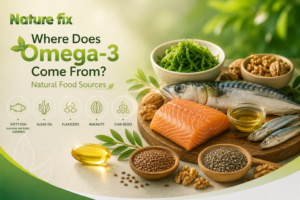
The human body cannot produce EPA or DHA on its own. Every milligram your body uses has to come from outside either from the food you eat or a supplement you take. The richest natural sources of Omega-3 are:
- Salmon — one of the highest sources of EPA and DHA per serving, ideally eaten two to three times a week
- Sardines — small but nutritionally dense, with excellent Omega-3 content and widely available
- Mackerel — a flavourful oily fish that delivers significant EPA and DHA alongside other key nutrients
- Herring — often overlooked but rich in Omega-3 and easy to include in a varied diet
- Walnuts the best plant-based source of Omega-3, though they contain ALA rather than EPA and DHA directly
- Flaxseed and chia seeds useful additions but again in ALA form, which the body converts to EPA and DHA only in small amounts
The practical reality is that most people do not eat enough oily fish to consistently meet their EPA and DHA needs. Recommended intake for adults is at least 500mg of combined EPA and DHA per day. The average daily dietary intake sits around 86mg less than one fifth of what is recommended.
Important Distinction: Plant-based ALA (found in flaxseed and walnuts) is not the same as EPA and DHA. The body converts very little ALA into usable EPA and DHA. For meaningful Omega-3 benefits, fish oil or marine-sourced supplementation is the most reliable approach.
How Much Omega-3 Do You Need as You Age?
General nutrition guidelines suggest a minimum of 250mg to 500mg of combined EPA and DHA per day for healthy adults. For older adults specifically, or those managing cardiovascular, joint, or cognitive concerns, many health practitioners recommend higher daily intakes often in the range of 1,000mg or more.
Nature Fix Omega-3 Fish Oil 1650mg delivers exactly that 1000mg of active Omega-3 per softgel, combining EPA 600mg and DHA 400mg in a single easy daily capsule. There is no complicated dosing, no multiple tablets, and no guesswork.
✔ Take one softgel daily with your main meal. The fat content in food helps your body absorb the Omega-3 more efficiently.
✔ Take it at a consistent time each day. The benefits of Omega-3 are cumulative regularity matters more than anything else.
✔ Give it at least eight weeks. Meaningful changes in joint comfort, skin condition, and mental clarity take time to become noticeable.
✔ Pair it with a balanced diet. Omega-3 works best as part of a wider approach to nutrition, not as a standalone fix.
Ready to get started? Visit getnaturefix.com to order Nature Fix Omega-3 Fish Oil 1650mg from $25.00 with a Subscribe and Save option available.
Why Nature Fix Omega-3 Is Built for Healthy Aging
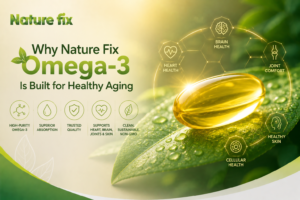
Not all fish oil supplements are created equal. The Omega-3 market is full of products with misleading labels, low active fatty acid content, and poor-quality fish oil that has not been properly purified.
Nature Fix Omega-3 Fish Oil 1650mg is different in the ways that actually matter:
- Triple-strength formula — 1650mg fish oil with 1000mg active Omega-3 per single softgel
- Wild-caught ocean fish — not farmed, not low-grade fish meal
- Rigorously purified — processed to remove heavy metals and environmental contaminants
- Clean ingredients — no artificial colours, flavours, fillers, gluten, or soy
- Softgel delivery — optimised for absorption at the right stage of digestion
- Honest labelling — what you see on the label is exactly what is in the capsule
Whether you are in your forties and thinking ahead, or in your sixties and already feeling the effects of aging on your joints, heart, or mental clarity Nature Fix Omega-3 is built to support your body through every stage.
Browse the complete Nature Fix supplement range at getnaturefix.com and find the right products for your daily wellness routine.
Final Thoughts
Healthy aging does not happen by accident. It is the result of small, consistent daily choices that add up over months and years. Omega-3 is one of those choices quiet, simple, and backed by decades of research.
Your heart works for you every single hour of every single day. Your brain handles everything you think, feel, and experience. Your joints carry you through life. Your skin faces the world on your behalf. Each of these deserves to be supported.
One softgel a day. One less thing to worry about. A whole lot of long-term difference.
Start today at getnaturefix.com because the best time to support your body is always right now.