If there is one nutrient that your body genuinely cannot function without, it is protein. Not because it is trendy. Not because fitness influencers talk about it constantly. But because your body uses it for almost everything building muscle, repairing tissue, producing hormones, powering your immune system, and even keeping your hair, skin, and nails in good shape.
And yet, most people have a very vague idea of how much protein they actually need, where the best sources are, and whether they are getting enough of it on a day-to-day basis.
This guide answers all of that in plain, simple language. No confusing science. No conflicting advice. Just a clear, practical breakdown of protein what it does, how much you need, and how to get it right without turning every meal into a calculation.
01 What Is Protein and What Does It Actually Do?
Protein is one of the three main macronutrients your body needs in large amounts every day, alongside carbohydrates and fats. But unlike the other two, protein is not primarily used as an energy source. Its main job is structural it is the material your body uses to build, maintain, and repair things.
Proteins are made up of smaller units called amino acids. Think of amino acids as individual building blocks, and protein as the structure made from them. Your body needs twenty different amino acids in total. Nine of these known as essential amino acids cannot be made by the body and must come from what you eat.
Here is a quick look at what protein is responsible for across the body:
- Building and maintaining muscle tissue — including the heart, which is a muscle too
- Producing enzymes that drive every chemical reaction in your body
- Creating hormones including insulin, growth hormone, and thyroid hormones
- Supporting immune function — antibodies are proteins
- Transporting nutrients through the bloodstream — haemoglobin, which carries oxygen, is a protein
- Maintaining healthy hair, skin, and nails — all made primarily from protein
- Helping your body recover from injury, illness, and physical exertion
02 How Much Protein Do You Actually Need Each Day?
This is the question most people want answered and the honest answer is that it depends on your body weight, your activity level, your age, and your goals.
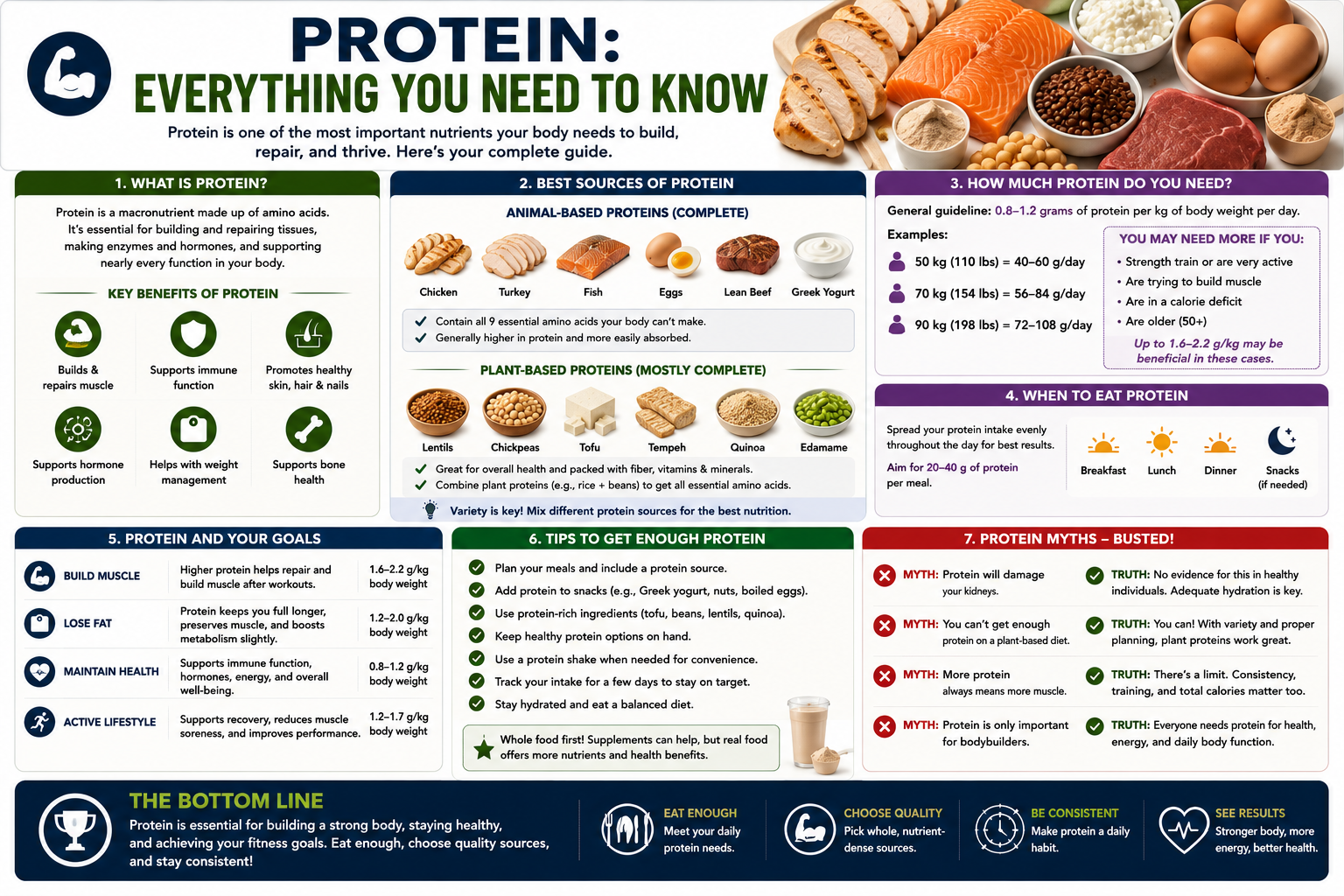
The absolute minimum recommended for a sedentary adult is 0.8 grams of protein per kilogram of body weight per day. For a 70kg person, that works out to around 56g of protein daily. But this minimum is just that the lowest amount to prevent deficiency, not the amount needed to feel your best or support an active life.
Most nutrition researchers now suggest that the optimal range for most active adults sits considerably higher. Here is a practical guide based on who you are and what you are doing:
| Who You Are | Daily Protein Target |
| Sedentary adult (desk job, low activity) | 0.8g per kg of bodyweight |
| Moderately active adult | 1.2 – 1.4g per kg of bodyweight |
| Regularly active / gym-goer | 1.6 – 2.0g per kg of bodyweight |
| Athlete or heavy trainer | 2.0 – 2.4g per kg of bodyweight |
| Older adult (60+) | 1.2 – 1.6g per kg of bodyweight |
| Pregnant or breastfeeding | Add 25g above your usual daily target |
To put that into everyday numbers: if you weigh 70kg and you are moderately active, you are likely looking at somewhere between 84g and 98g of protein per day. That is roughly three to four palm-sized servings of a protein-rich food spread across your meals.
03 The Best Food Sources of Protein
Not all protein sources are equal. What matters most nutritionally is the quality of the protein — specifically whether it contains all nine essential amino acids in useful amounts. Foods that do are called complete proteins. Those that do not are called incomplete.
Animal-based foods are generally complete proteins. Most plant-based sources are incomplete, though combining different plant foods throughout the day can cover all essential amino acids effectively.
Here is a reference guide to some of the most useful protein sources and how much protein they actually deliver:
| Food Source | Serving Size | Protein Content | Type |
| Chicken breast | 100g cooked | ~31g | Animal |
| Eggs | 2 large eggs | ~12g | Animal |
| Canned tuna | 100g drained | ~25g | Animal |
| Greek yoghurt | 170g serving | ~17g | Animal |
| Cottage cheese | 100g | ~11g | Animal |
| Lentils | 100g cooked | ~9g | Plant |
| Chickpeas | 100g cooked | ~9g | Plant |
| Tofu (firm) | 100g | ~8g | Plant |
| Quinoa | 100g cooked | ~4g | Plant |
| Almonds | 30g handful | ~6g | Plant |
A few things worth noting from this list:
- Eggs are often called the gold standard of protein quality because they contain all essential amino acids in near-perfect proportions for human use
- Greek yoghurt and cottage cheese are underrated high-protein options that are easy to build into snacks and breakfast
- For plant-based eaters, combining lentils or chickpeas with a grain like rice or quinoa across the day provides a full amino acid profile
- Nuts and seeds contribute protein but should not be relied on as primary sources they are more useful as additions to an already protein-rich meal
04 When You Eat Protein Matters More Than You Think
Most people think about total daily protein but overlook how they distribute it across the day. And it turns out, this matters more than many people realise.
Your body can only use a certain amount of protein for muscle building and repair at any one time. Research consistently suggests that spreading protein intake across three to four meals or eating occasions rather than front-loading or back-loading it leads to better muscle protein synthesis throughout the day.
What this looks like in practice:
- Aim for 20 to 40 grams of protein per main meal, depending on your daily target
- Do not skip protein at breakfast a protein-rich morning meal reduces hunger and stabilises energy throughout the morning
- Include protein at or around the time of physical activity if you exercise the window is wider than once thought but still relevant
- Do not rely on one large high-protein meal at dinner to compensate for low protein earlier in the day the body does not store it the way it does fat
For people who struggle to consistently hit their protein target through food alone particularly around busy mornings or on days when appetite is low a high-quality protein supplement can be a practical and effective way to bridge the gap without additional meal planning.
Explore protein support options at getnaturefix.com.
05 Protein and Muscle Not Just for Gym-Goers
When most people hear “protein for muscle,” they picture weightlifters and protein shakes. But the reality is that muscle maintenance is relevant to every single adult not just those who train.
Your muscles are your metabolic engine. They burn more energy at rest than fat tissue does, help regulate blood sugar, keep your joints stable and protected, and play a central role in physical independence as you age. Losing muscle is not just an aesthetic concern —it is a health one.
And muscle loss is happening to most adults who are not actively doing something to prevent it. From around the age of 30 onwards, the body begins to gradually lose muscle mass a process that accelerates significantly after 50 unless it is actively countered with two things: adequate protein intake and regular physical activity.
You do not need to lift heavy weights to protect your muscle mass, though resistance exercise is the most effective tool available. Even regular walking paired with adequate daily protein can meaningfully slow age-related muscle loss compared to a sedentary, low-protein lifestyle.
✔ If you do exercise even moderately make sure you eat a protein-containing meal or snack within a few hours of finishing. This is when your muscles are most receptive to the amino acids they need for repair and growth.
✔ Older adults benefit particularly from leucine-rich protein sources like eggs, chicken, and dairy — leucine is the amino acid most directly involved in triggering muscle protein synthesis.
✔ Consistency matters more than precision. Hitting your protein target most days is far more valuable than occasional high-protein days with long gaps in between.
06 Protein and Weight Management The Underrated Connection
If you have ever tried to manage your weight and found yourself hungry all the time, irritable between meals, and constantly thinking about food there is a good chance your protein intake was too low.
Protein is the most filling macronutrient. It takes longer to digest than carbohydrates, triggers satiety hormones more effectively than fat, and reduces the kind of hunger signals that lead to mindless snacking and overeating later in the day.
There is also a metabolic advantage. Digesting protein burns more calories than digesting carbohydrates or fat a phenomenon known as the thermic effect of food. Around 20 to 30 percent of the calories in protein are used just in the process of digesting and using it, compared to 5 to 10 percent for carbohydrates and 0 to 3 percent for fat.
What this means in practice:
- Higher protein meals keep you fuller for longer, reducing total calorie intake without the need for strict restriction
- Protein helps preserve muscle mass during weight loss which matters because losing muscle slows your metabolism
- Starting the day with a high-protein breakfast measurably reduces hunger and total calorie intake throughout the day according to multiple studies
- Swapping a high-carbohydrate snack for a protein-rich one such as Greek yoghurt, hard-boiled eggs, or a handful of nuts reduces mid-afternoon energy crashes and food cravings
07 Signs Your Body May Need More Protein
Most protein deficiency in everyday life is not dramatic. You will not collapse or develop visible symptoms overnight. But your body will give you signals subtle ones that most people miss or attribute to other causes.
Watch out for these signs that your daily protein intake may be falling short:
- You feel hungry again within one to two hours of eating a main meal especially if that meal was carbohydrate-heavy with little protein
- You are tired during the day despite adequate sleep low protein can impair energy production and neurotransmitter balance
- Your hair is thinning, breaking more easily, or growing slowly hair is made of protein and is one of the first things affected by a shortfall
- Your nails are weak, brittle, or slow to grow
- You are getting ill more frequently than usual the immune system depends heavily on protein to produce antibodies
- Recovery after exercise or physical activity feels slower than it used to
- You are losing muscle tone or strength without a clear reason
If several of these sound familiar, increasing your daily protein intake even modestly is a practical first step worth trying before looking for more complicated explanations.
08 How Nature Fix Supports Your Daily Protein Goals
Getting consistent protein through food alone is entirely possible but for many people, daily life gets in the way. Busy mornings, irregular meal times, travel, low appetite, or simply not enjoying high-protein foods can all create gaps that are hard to close through diet alone.
Nature Fix supplements are designed to work alongside a balanced diet not replace it. Whether you need Omega-3 support for joint and muscle recovery, a calcium and vitamin D formula to protect the bone and muscle partnership, or a targeted supplement to fill specific nutritional gaps, the Nature Fix range is built around clean, honest ingredients that complement what you are already eating.
The people who feel their best long-term are those who combine consistent protein intake from real food with targeted supplementation for the nutrients their diet consistently falls short on. That combination rather than either approach alone is where the real difference shows up.
✔ Pair a high-protein breakfast with your daily Nature Fix supplements for a morning routine that sets your nutrition up right from the first hour of the day.
✔ On days when hitting your protein target through food feels difficult, a clean protein supplement can close the gap without adding complexity to your routine.
✔ If you exercise, prioritise protein-rich meals around your training and support recovery with the micronutrients particularly Omega-3 and magnesium that work alongside protein to rebuild muscle effectively.
Explore the complete Nature Fix range at getnaturefix.com and find what your daily nutrition routine is missing.
Feed your body protein it can use. Every day. That is the whole secret.
Support your daily nutrition goals with clean, effective supplements from getnaturefix.com because what you put into your body every day is what your body becomes.
This article is for general informational purposes only and does not constitute medical advice. Please consult a qualified healthcare professional before making significant changes to your diet or supplement routine. © 2026 Nature Fix. All rights reserved. | getnaturefix.com